Published
- KRW 112.72/kWh
- Integrated SMP, 2025 annual average
- KRW 196.65/kWh
- Integrated SMP, 2022 annual average
Contents (7)
Picture filling a big tub at a public bathhouse. There are several taps, and the water from each tap costs a different amount. You open the cheapest tap first. If that's not enough, you open the next cheapest. You keep opening taps until the tub is full. Then the price of the water from the last tap you opened becomes the price of all the water in the tub for that hour. It sounds like strange math, but this is the main idea of how the wholesale price of electricity is set (the rules have exceptions, covered later).
Electricity made at power plants is pooled and sold together in the power market. The name of the wholesale price attached to each hour is the system marginal price, SMP (System Marginal Price) SMP is the energy price set for each trading hour in the power market. It is the highest generation price among the generators eligible to set the price in that hour. Glossary → for short. It means the price set by the last unit (the margin) across the whole power grid (the system). But this is a shortened explanation; the calculation set by the rules is looked at separately later. When the news says "wholesale power prices went up," this is usually the price it means. Know how this price is set, and you can tell what that news is really saying has gotten more expensive.
When, and in what order, is the line formed?
SMP is set the day before the electricity is actually used. The Korea Power Exchange (KPX) forecasts demand for each hour of the next day and draws up a generation plan that meets that demand at the lowest cost. This is the day-ahead generation schedule. The rules say this schedule must be drawn up with the aim of "minimizing total generation costs and demand-reduction costs."Source 1Korea Power Exchange (KPX), *Electricity Market Operation Rules* (「전력시장운영규칙」, version in force from 2026-07-25; unofficial translation), Art. 5.1.1 (Drawing up the day-ahead generation schedule)· Art. 5.1.2 (Notice of the day-ahead generation schedule, 17:00 on the day before trading)· Art. 2.4.2 (Determination of the system marginal pricethe highest effective generation price; 0 won/kWh without price-setting eligibility) (article titles: unofficial translation)See in sources →
It is built from three ingredients. The first is the bids generating companies submit (not naming a price, but stating how much each generator can run the next day). The second is the generation cost data each generator has had assessed in advance. The third is the demand forecast. As a rule, the result goes out to generating companies by 17:00 on the day before trading.Source 1Korea Power Exchange (KPX), *Electricity Market Operation Rules* (「전력시장운영규칙」, version in force from 2026-07-25; unofficial translation), Art. 5.1.1 (Drawing up the day-ahead generation schedule)· Art. 5.1.2 (Notice of the day-ahead generation schedule, 17:00 on the day before trading)· Art. 2.4.2 (Determination of the system marginal pricethe highest effective generation price; 0 won/kWh without price-setting eligibility) (article titles: unofficial translation)See in sources →
To keep costs as low as possible, you use the cheapest generators first. Generators are lined up from lowest cost to highest and called on in turn until that hour's demand is fully met. This order is the Dispatch and Merit Order Dispatch is KPX telling generators when and how much to run. In principle it follows the market's priority order: generators with the lowest variable cost run first. Glossary →. How different the water costs from tap to tap shows up in fuel cost alone. In 2025, the fuel cost of making 1 kWh was 6.39 won for nuclear, 73.70 won for bituminous coal, 124.20 won for LNG, and 319.07 won for oil-fired plants.Source 2Korea Power Exchange (KPX), *Fuel Costs* (「연료비용」, Electric Power Statistics Information System (EPSIS, 전력통계정보시스템), accessed 2026-10-23), 2025 annual fuel unit cost (won/kWh)generation-cost evaluation data reviewed and resolved by the Cost Evaluation Committee, averaged with weights by plant capacity. The multiple is a calculated value.See in sources → Water from the most expensive tap costs nearly 50 times as much as water from the cheapest.
At 4 a.m., a few cheap taps fill the tub. At 7 p.m., when homes turn on their lights and cook dinner, pricier taps have to be opened too. In September 2026, the hourly average SMP in the mainland power market was 97.6 won at 4 a.m. and 137.8 won at 7 p.m.Source 3Korea Power Exchange (KPX), *System Marginal Price and Demand Forecast OpenAPI* (「계통한계가격 및 수요예측 OpenAPI」, Public Data Portal 15131225; unofficial translation), simple average by hour, mainland, September 1–30, 2026Renuary calculation.See in sources → Same month, same generators, yet within a single day the price of 1 kWh rises by more than 40 won. That is why SMP differs from hour to hour. You can see it for yourself by moving the demand around in the SMP line-up tool.
Heights and widths are illustrative; the real order shifts with fuel prices, maintenance and output.
Why does the single most expensive unit set the price?
The rules set SMP like this: among the prices of the generators included in the schedule for that hour, the highest one is the SMP.Source 1Korea Power Exchange (KPX), *Electricity Market Operation Rules* (「전력시장운영규칙」, version in force from 2026-07-25; unofficial translation), Art. 5.1.1 (Drawing up the day-ahead generation schedule)· Art. 5.1.2 (Notice of the day-ahead generation schedule, 17:00 on the day before trading)· Art. 2.4.2 (Determination of the system marginal pricethe highest effective generation price; 0 won/kWh without price-setting eligibility) (article titles: unofficial translation)See in sources → This unit is called the "marginal" generator, and people often describe it simply as the unit that met the last bit of demand. A generator without price-setting eligibility has its price counted as 0 won (first point below), so the highest price always belongs to an eligible generator.
So who, in practice, was usually the last tap? Of the 8,760 hours in the 2025 mainland power market, LNG generators set the SMP in 7,295 hours, or 83%. Coal (bituminous) set it in 1,412 hours, and nuclear in 7.Source 4Korea Power Exchange (KPX), *SMP Setting by Fuel Source* (「연료원별 SMP결정」, EPSIS, accessed 2026-10-23), hours in which each fuel source set the mainland system marginal price2025 annual, 8,760 hours. The share is a calculated value.See in sources → In more than eight of every ten hours, the last tap was LNG. The cheapest tap opens first, but it rarely stands in the spot that sets the price.
Two things are worth pinning down.
First, not every generator sets the price. Each generator's right to set the price (price-setting eligibility) is decided separately under the rules, and the price of a generator without it is counted as 0 won, so it does not set the SMP. This piece could not confirm which generators lack eligibility.
Step heights only show the order (concept, no values). The rules decide which units lack eligibility; this figure does not list them.
Second, a generator's price is not whatever its owner feels like asking. It is calculated from the fuel cost of running as much as is scheduled in that hour. Three costs are added together: the cost of making each extra unit, the cost of simply keeping the generator running, and the cost of starting up a generator that is off. That is why Korea's power market is often called a cost-based market. Generators line up by what it costs them, not by what they ask.
SMP is only the market's benchmark for that hour, not all the money a generator receives. (There is also the Capacity Payment (CP) A capacity payment is paid for the available capacity a generator bids, apart from its output. It covers fixed costs, such as construction, that SMP alone can hardly recover. Glossary →, paid separately for capacity kept ready, and the Settlement Adjustment Factor It adjusts the settlements of generators at KEPCO majority-owned companies and of central-dispatch coal units. The rules place it among measures for power price stability. Glossary →, which reduces the share above fuel cost in what some generators are paid.)
How much did it differ year to year?
Since the price of the last unit is calculated from fuel cost, when that fuel gets more expensive, SMP rises with it. The annual average of the integrated SMP in KPX's *2025 Electricity Market Statistics* differed widely from year to year.Source 5Korea Power Exchange (KPX), *2025 Electricity Market Statistics* (「2025년도 전력시장 통계」, 2026-05), integrated SMP annual average.See in sources → "Integrated SMP" is the name the statistics use; this piece could not confirm what was combined into it, or whether it is on the same basis as the mainland hourly values below. So this piece does not mix this annual average with the hourly values in one calculation.
It came down from 196.65 won in 2022 to 112.72 won in 2025.
Data Korea Power Exchange (KPX), 2025 Electricity Market Statistics (「2025년도 전력시장 통계」)·PNG
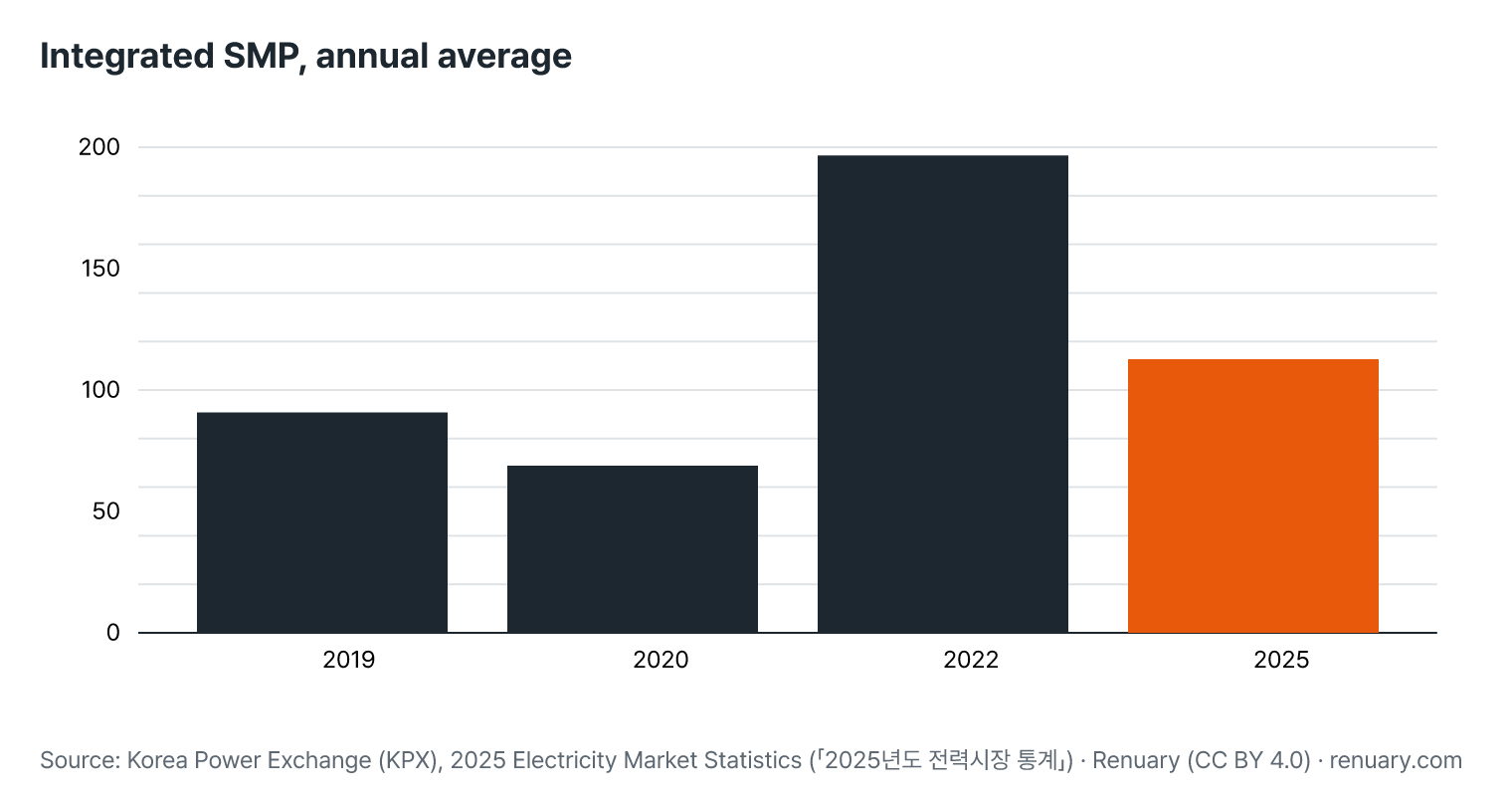
The annual average was 196.65 won/kWh in 2022 (kWh is the kilowatt-hour, the unit that measures the amount of electricity used) and 112.72 won/kWh in 2025. Over three years it came down by more than 40% (about 43%). Even under the same rules, the price of the whole market moved this much. This piece could not confirm whether the fall in between came from particular fuel prices or from a change in which generators were called on.
If SMP goes up, does my home bill go up too?
Suppose a home uses 300 kWh a month. If the 300 kWh this home used were counted at the wholesale price SMP alone, it would come to about 34,000 won at 112.72 won and about 59,000 won at 196.65 won. That does not mean this home's bill swings up and down by that much. What a home pays for electricity is charged not at SMP but by a fixed rate table. Between SMP and your bill stand two things: KEPCO (Korea Electric Power Corporation), which buys electricity in the wholesale market, and the rate table the government approves, which sets what you pay.
So when the news says "SMP went up," it does not mean every power plant got more expensive. It means that in that hour a more expensive generator had to be called on, or the fuel price of the last unit went up. In bathtub terms, either the last tap opened was a different one, or the water from that tap got pricier. In 2025, that tap was usually LNG. And SMP is not the same thing as the electricity bill.
What to watch when using this number
If you handle SMP in a report or analysis, four points are worth noting.
- The annual average squeezes values that differ every hour into one number for the year. The ups and downs of the day and the seasons are erased.
- The generator that set the SMP is not the only generator paid in that hour. Generators without price-setting eligibility also run and get paid. Only when setting the SMP is their price counted as 0 won.
- SMP is not the only money a generator receives. Generators get separate money for capacity kept ready, and some generators have the share above fuel cost in what they are paid reduced by an adjustment.
- The fuel cost by source is a yearly average weighted by plant capacity, and only one part of a generator's price. The hours in which 'LNG set the price' count the mainland market only.
So, if you know the last unit
The price for an hour is set by the highest price among the generators in that hour's schedule that are eligible to set the price. Look at which unit that is and what its fuel costs, and you have a clue to why the SMP went up or down.
Yet in the same hour, at the same SMP, the money that lands in each power plant's bank account is different. Why that happens is followed up in "Same price, different paycheck."
Words in this piece
- SMP (System Marginal Price) SMP is the energy price set for each trading hour in the power market. It is the highest generation price among the generators eligible to set the price in that hour. Glossary → — the wholesale price of electricity, set for each hour. It is the highest price among the generators in that hour's schedule that have price-setting eligibility.
- Dispatch and Merit Order Dispatch is KPX telling generators when and how much to run. In principle it follows the market's priority order: generators with the lowest variable cost run first. Glossary → — the order in which generators are lined up from lowest cost to highest and called on in turn.
Source 1Korea Power Exchange (KPX), *Electricity Market Operation Rules* (「전력시장운영규칙」, version in force from 2026-07-25; unofficial translation), Art. 5.1.1 (Drawing up the day-ahead generation schedule)· Art. 5.1.2 (Notice of the day-ahead generation schedule, 17:00 on the day before trading)· Art. 2.4.2 (Determination of the system marginal pricethe highest effective generation price; 0 won/kWh without price-setting eligibility) (article titles: unofficial translation)See in sources →: Korea Power Exchange (KPX), More precisely *1Electricity Market Operation Rules*(https://www.kpx.or.kr/board.es?mid=a10205010000&bid=0030) (「전력시장운영규칙」, version in force from 2026-07-25; unofficial translation), Art. 5.1.1 (Drawing up the day-ahead generation schedule) · Art. 5.1.2 (Notice of the day-ahead generation schedule, 17:00 on the day before trading) · Art. 2.4.2 (Determination of the system marginal price — the highest effective generation price; 0 won/kWh without price-setting eligibility) (article titles: unofficial translation) Source 2Korea Power Exchange (KPX), *Fuel Costs* (「연료비용」, Electric Power Statistics Information System (EPSIS, 전력통계정보시스템), accessed 2026-10-23), 2025 annual fuel unit cost (won/kWh)generation-cost evaluation data reviewed and resolved by the Cost Evaluation Committee, averaged with weights by plant capacity. The multiple is a calculated value.See in sources →: Korea Power Exchange (KPX), More precisely *2Fuel Costs*(https://epsis.kpx.or.kr/epsisnew/selectEkmaFucUpfChart.do?menuId=040100) (「연료비용」, Electric Power Statistics Information System (EPSIS, 전력통계정보시스템), accessed 2026-10-23), 2025 annual fuel unit cost (won/kWh) — generation-cost evaluation data reviewed and resolved by the Cost Evaluation Committee, averaged with weights by plant capacity. The multiple is a calculated value. Source 3Korea Power Exchange (KPX), *System Marginal Price and Demand Forecast OpenAPI* (「계통한계가격 및 수요예측 OpenAPI」, Public Data Portal 15131225; unofficial translation), simple average by hour, mainland, September 1–30, 2026Renuary calculation.See in sources →: Korea Power Exchange (KPX), More precisely *3System Marginal Price and Demand Forecast OpenAPI*(https://www.data.go.kr/data/15131225/openapi.do) (「계통한계가격 및 수요예측 OpenAPI」, Public Data Portal 15131225; unofficial translation), simple average by hour, mainland, September 1–30, 2026 — Renuary calculation. Source 4Korea Power Exchange (KPX), *SMP Setting by Fuel Source* (「연료원별 SMP결정」, EPSIS, accessed 2026-10-23), hours in which each fuel source set the mainland system marginal price2025 annual, 8,760 hours. The share is a calculated value.See in sources →: Korea Power Exchange (KPX), More precisely *4SMP Setting by Fuel Source*(https://epsis.kpx.or.kr/epsisnew/selectEkmaSmpNsmChart.do?menuId=040203) (「연료원별 SMP결정」, EPSIS, accessed 2026-10-23), hours in which each fuel source set the mainland system marginal price — 2025 annual, 8,760 hours. The share is a calculated value. Source 5Korea Power Exchange (KPX), *2025 Electricity Market Statistics* (「2025년도 전력시장 통계」, 2026-05), integrated SMP annual average.See in sources →: Korea Power Exchange (KPX), More precisely *52025 Electricity Market Statistics*(https://new.kpx.or.kr/boardDownload.es?bid=0089&list_no=77105&seq=3) (「2025년도 전력시장 통계」, 2026-05), integrated SMP annual average.
Sources (5)
Sources
- LawKorea Power Exchange (KPX), *Electricity Market Operation Rules* (「전력시장운영규칙」, version in force from 2026-07-25; unofficial translation), Art. 5.1.1 (Drawing up the day-ahead generation schedule)· Art. 5.1.2 (Notice of the day-ahead generation schedule, 17:00 on the day before trading)· Art. 2.4.2 (Determination of the system marginal price ↩the highest effective generation price; 0 won/kWh without price-setting eligibility) (article titles: unofficial translation)
- DataKorea Power Exchange (KPX), *Fuel Costs* (「연료비용」, Electric Power Statistics Information System (EPSIS, 전력통계정보시스템), accessed 2026-10-23), 2025 annual fuel unit cost (won/kWh) ↩generation-cost evaluation data reviewed and resolved by the Cost Evaluation Committee, averaged with weights by plant capacity. The multiple is a calculated value.
- DataKorea Power Exchange (KPX), *System Marginal Price and Demand Forecast OpenAPI* (「계통한계가격 및 수요예측 OpenAPI」, Public Data Portal 15131225; unofficial translation), simple average by hour, mainland, September 1–30, 2026 ↩Renuary calculation.
- DataKorea Power Exchange (KPX), *SMP Setting by Fuel Source* (「연료원별 SMP결정」, EPSIS, accessed 2026-10-23), hours in which each fuel source set the mainland system marginal price ↩2025 annual, 8,760 hours. The share is a calculated value.
- DataKorea Power Exchange (KPX), *2025 Electricity Market Statistics* (「2025년도 전력시장 통계」, 2026-05), integrated SMP annual average. ↩
Ask about this postQuestions shape the next pieces
Comments
- Loading…